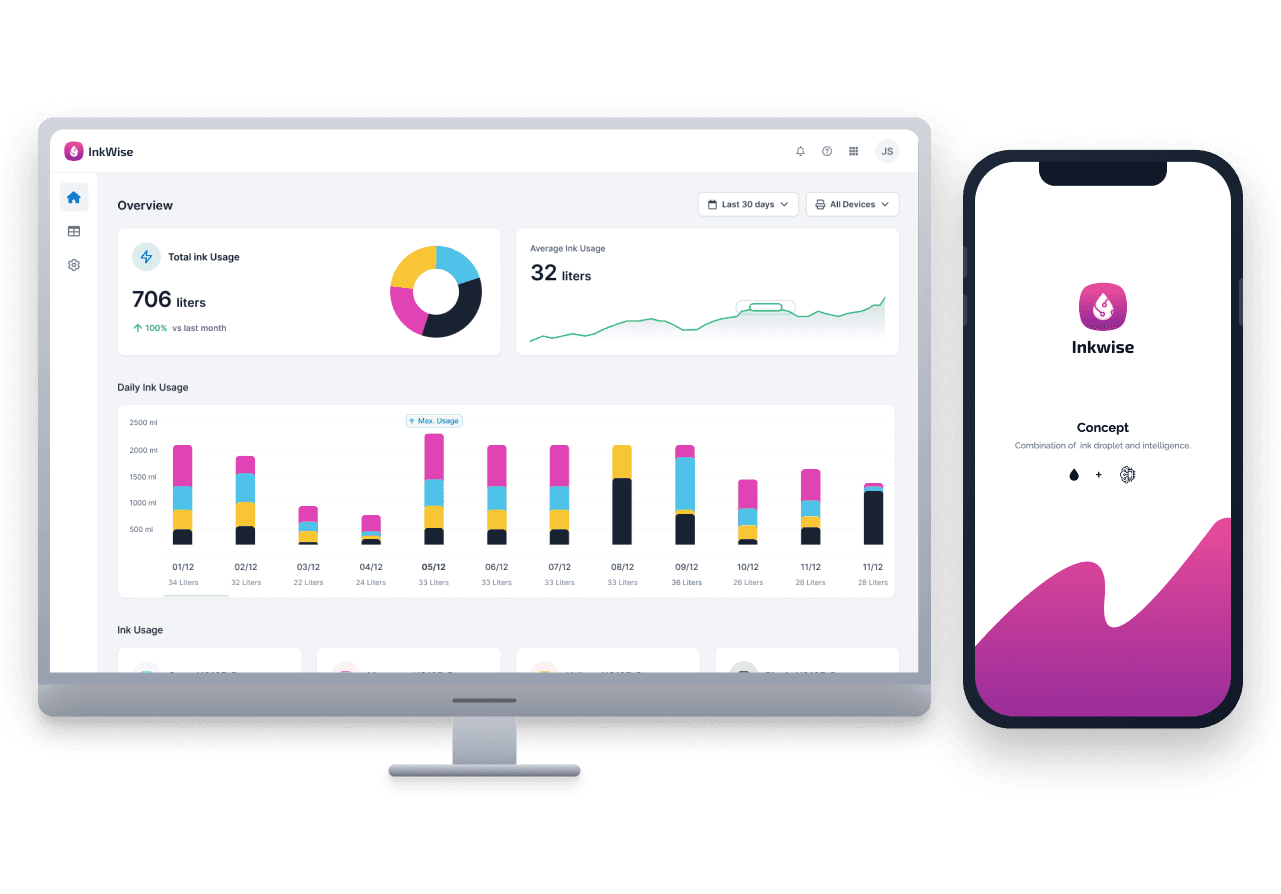
InkWise is an AI-driven inventory tool for the print industry. I joined at the discovery stage as a UX Researcher my job was to figure out whether the problem was real, who it actually affected, and what a solution could look like.
Role & Responsibilities
Led the end-to-end product lifecycle, from early market discovery through launch, post-launch validation, and success tracking.
Analyzed complex market landscapes to identify high-impact problem spaces and directly shape product roadmap priorities.
Built the product narrative and executive-ready business cases, translating technical insights into clear strategic recommendations.
Partnered with Marketing to run market research in the print industry, with a focus on ink usage, waste, and efficiency drivers.
Synthesized industry trends, reports, and competitive data into actionable insights for product, research, and business stakeholders.
Supported cross-functional alignment across research, business, and product teams to ensure direction matched market needs.
Goals
To support a data-backed justification for building the product
To clearly communicate market-level challenges to stakeholders
To inform and guide subsequent user research and product discovery phases
Understanding the Market Landscape
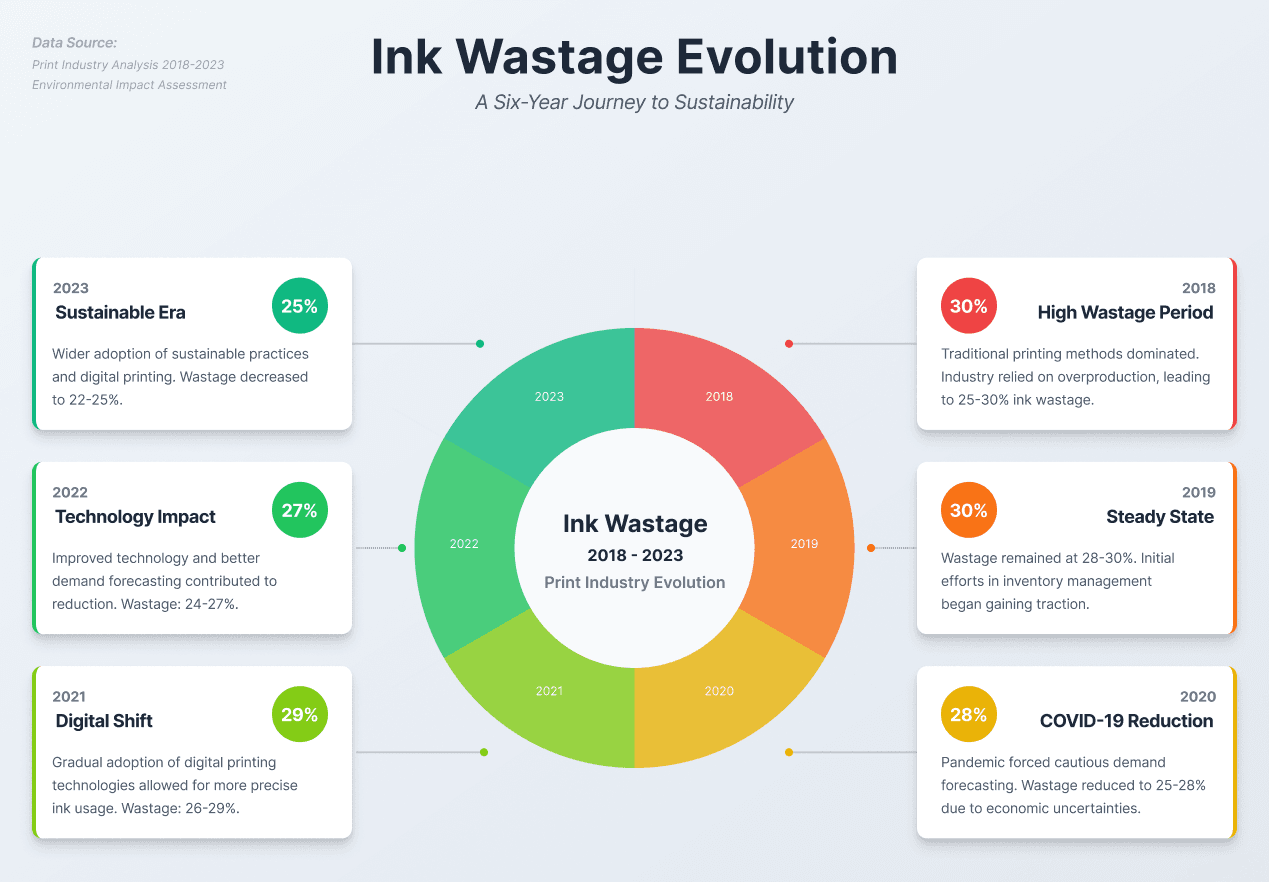
As part of the discovery phase, we conducted research to understand the broader print industry and identify persistent market-level challenges. This involved analyzing industry reports, market data, and trend analyses related to ink usage and wastage.
Between 2018 and 2023, estimates suggest that ink wastage can account for up to $24–25.5 billion
only a modest reduction despite advancements in digital printing technologies. These insights helped establish the scale of the problem and supported the need for further investigation.
Understanding Real-World Workflows
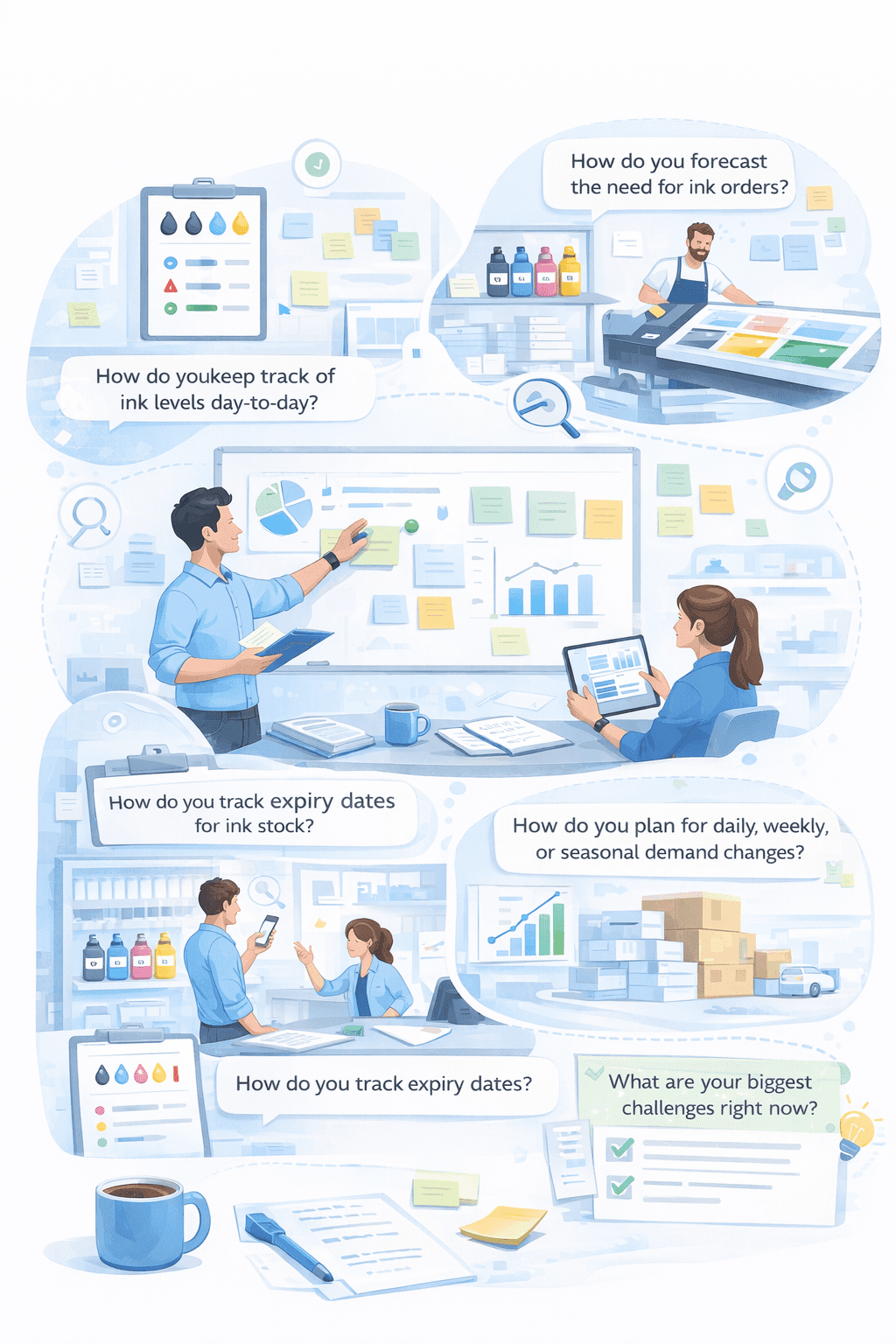
While initial research highlighted the scale of ink wastage at an industry level, it did not explain how the problem manifests in day-to-day operations. To bridge this gap, we conducted Field Study by engaging directly with print shop owners.
Through conversations and workflow discussions, we explored how inventory is managed,
"One thing that stood out immediately was most shop owners were tracking ink stock on paper or in their heads. There was no system. The gap between what they thought they had and what was actually on the shelf was bigger than we expected."
Understanding Decisions Behind Workflows
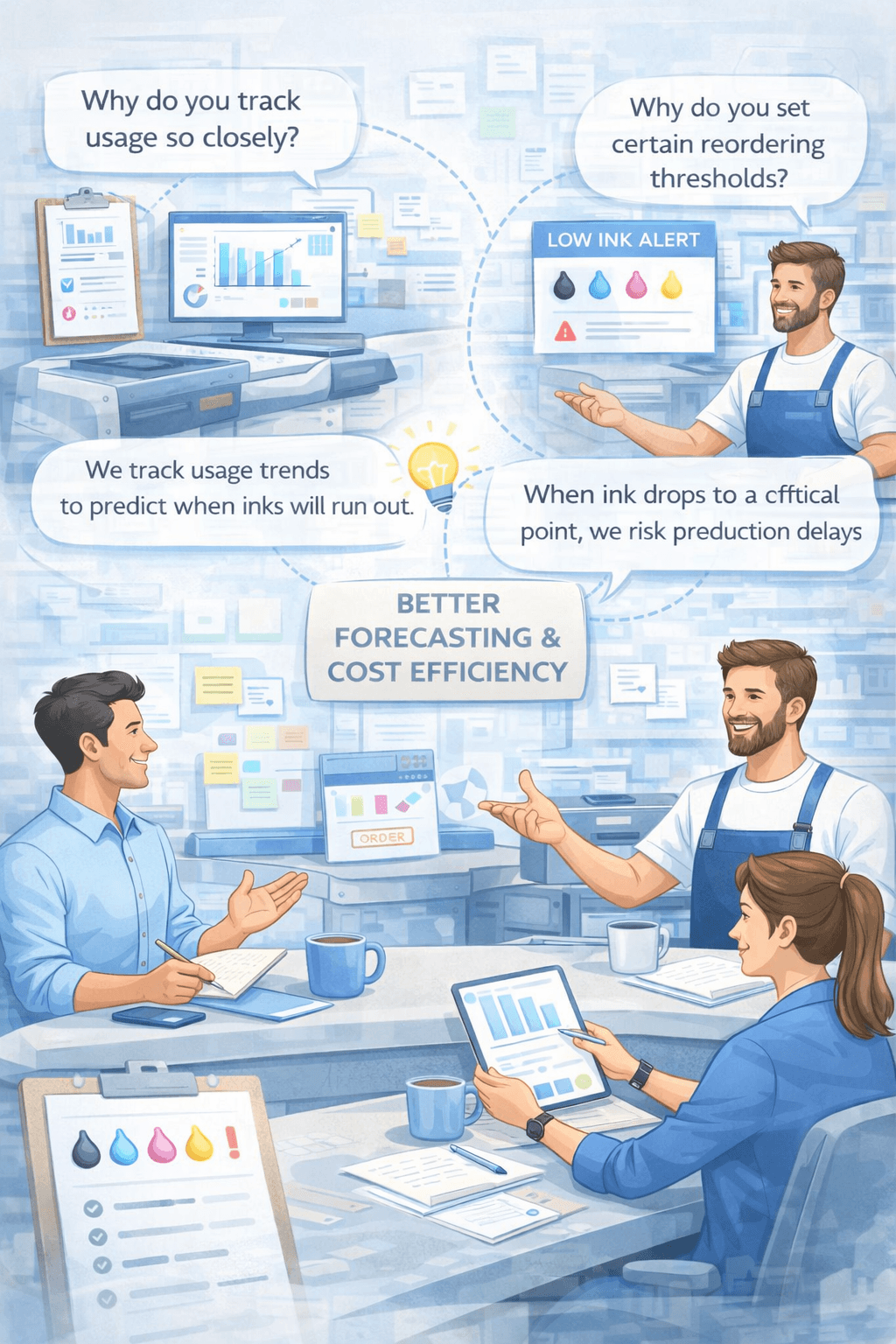
After the field study, we conducted semi-structured interviews with print shop owners to understand the reasoning behind their workflows and decisions. While observation helped identify what was happening, the interviews clarified why these practices existed.
Interviews revealed that print shop owners were making reorder decisions based on gut feeling rather than data, often leading to panic buying.
"The biggest shift for us was realizing shop owners weren't avoiding better systems because they didn't care, they were avoiding them because any new tool added more work than it saved. That became a core design constraint."
Uncovering Patterns
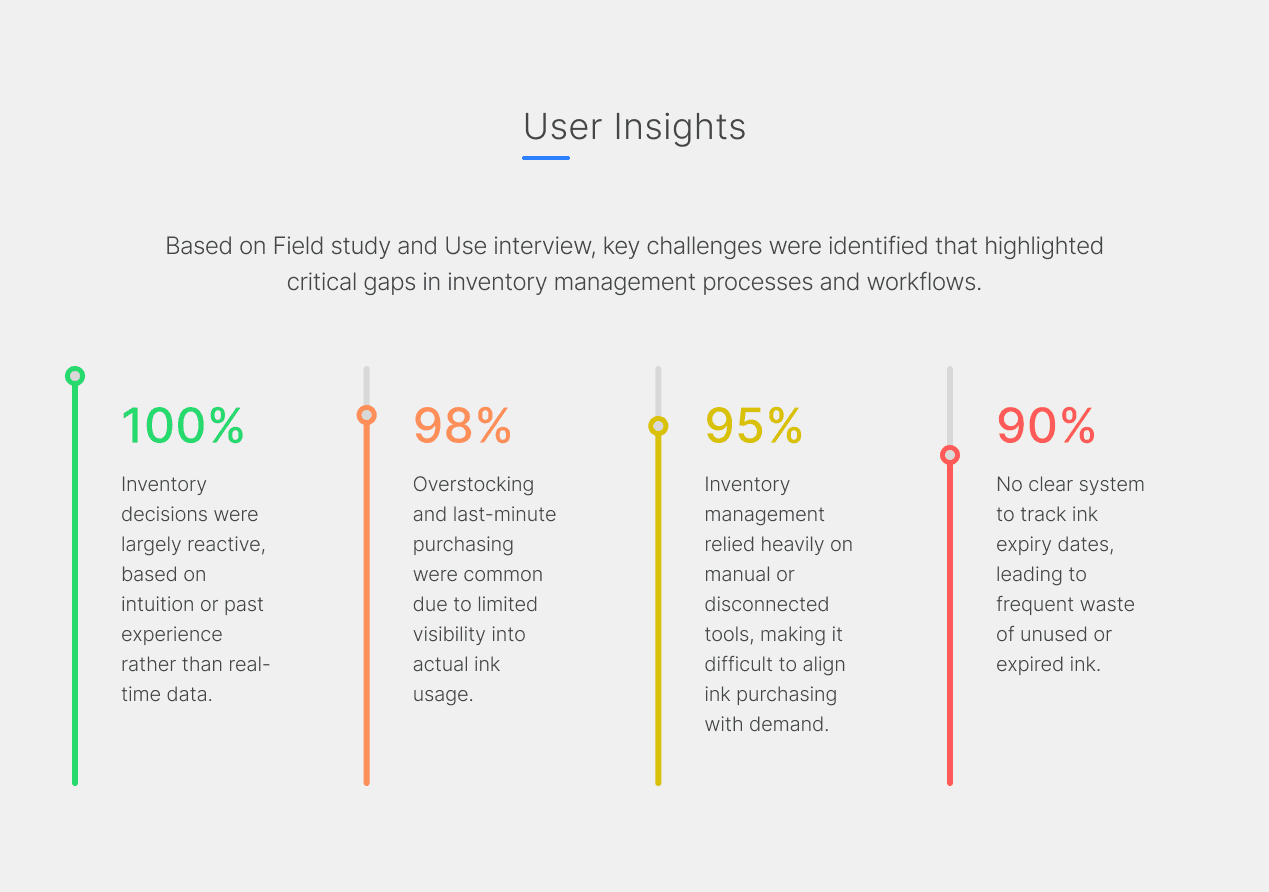
After conducting primary research, we synthesized findings through affinity mapping to uncover key patterns and user insights.
Through affinity mapping, recurring behaviors and challenges surfaced, leading to the following user insights.
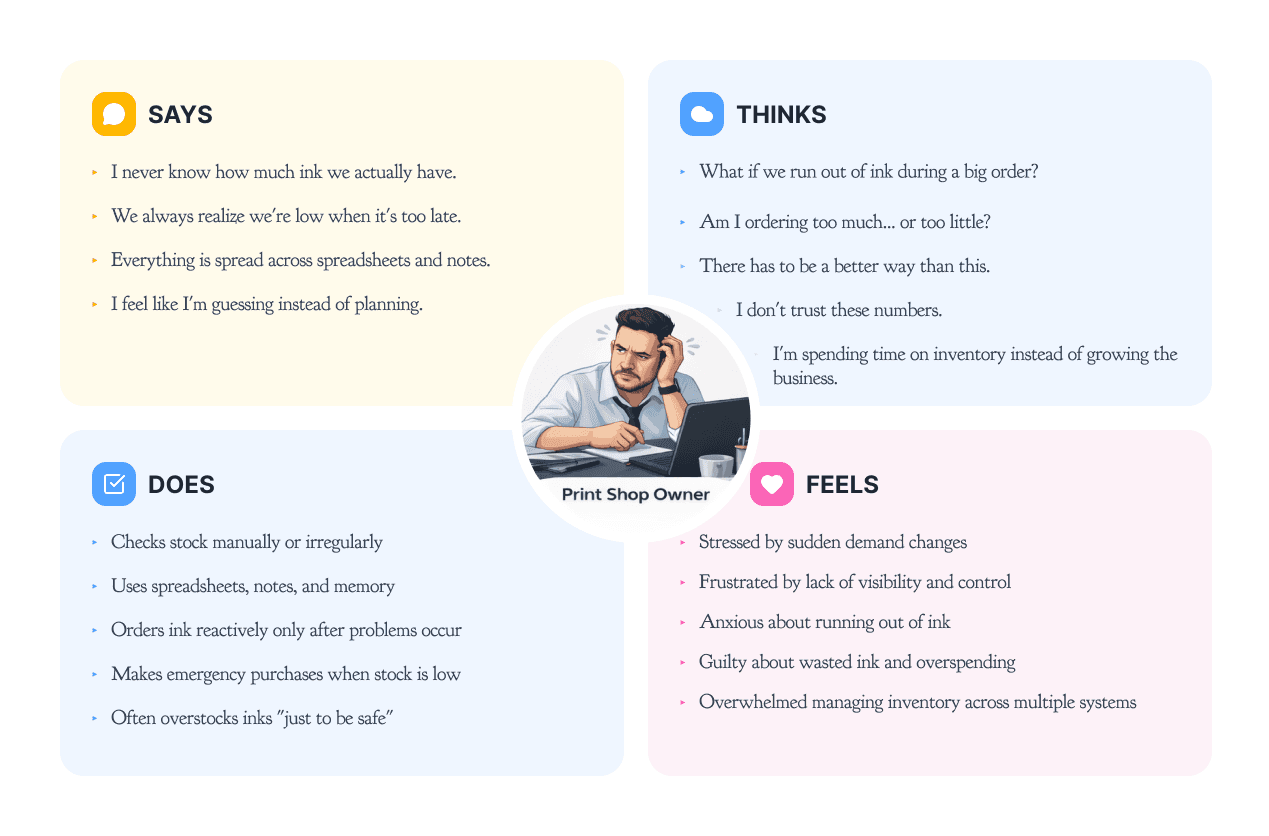
Empathy mapping helped translate operational challenges into emotional stress points, revealing how uncertainty and manual processes affect daily decision-making.
The Stress Behind the Workflow
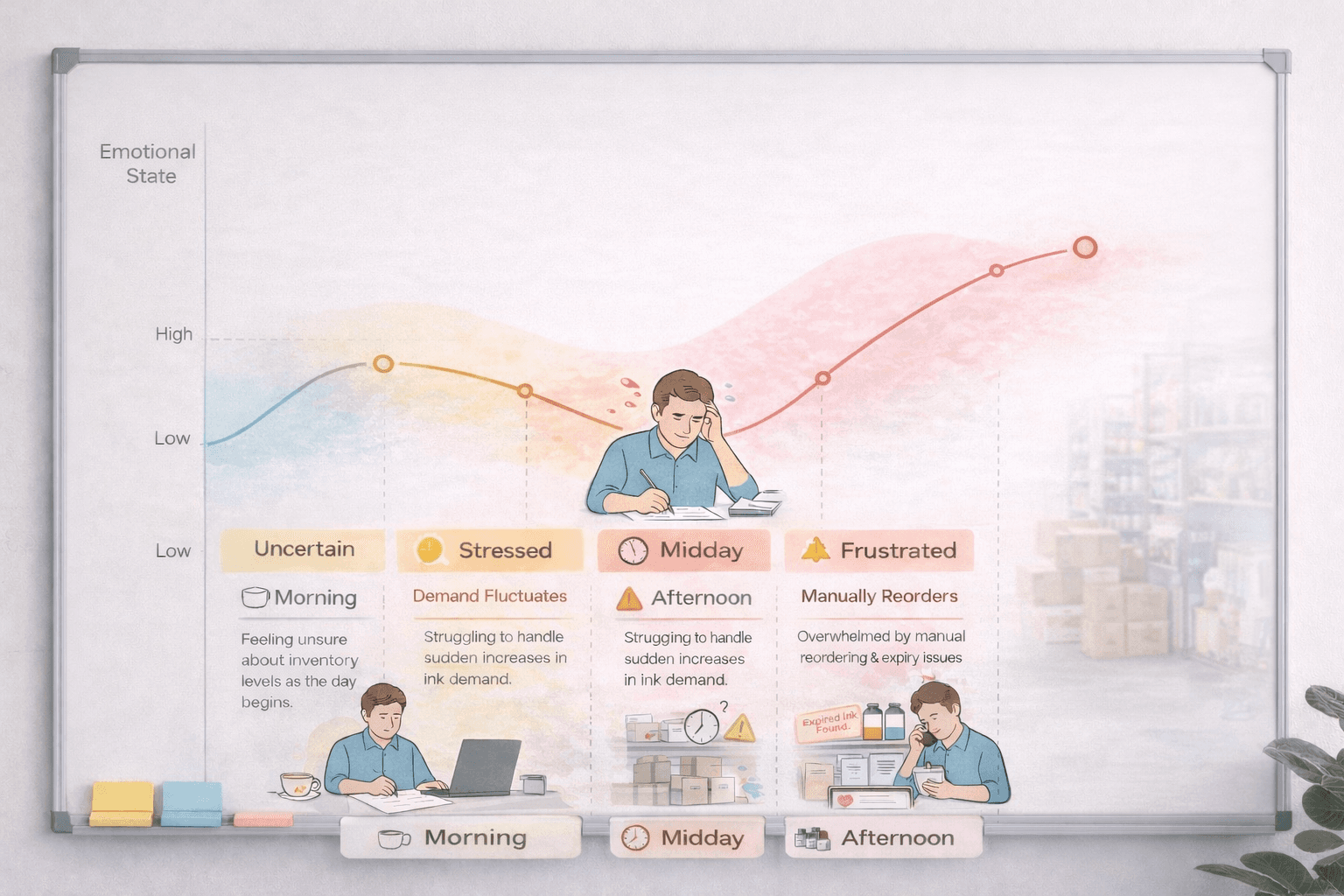
We mapped both everyday inventory workflows and critical inventory management scenarios. While the everyday journey established baseline behaviours, this emotional journey focuses on a critical inventory management day, where demand fluctuations, low stock, or expiry issues surface revealing moments of heightened stress caused by limited visibility and manual processes.
From Noise to Focus
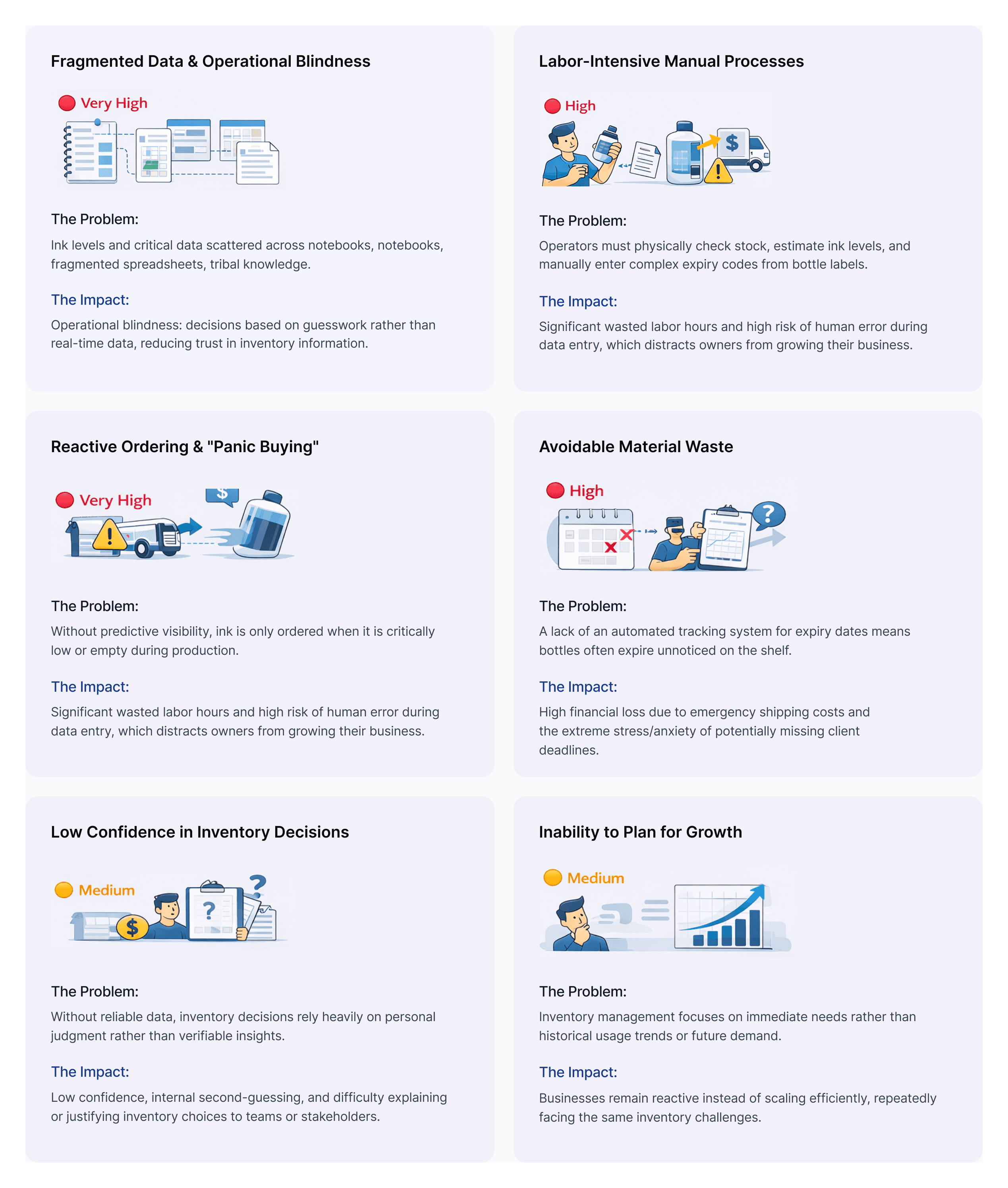
We first defined the problems objectively, then layered impact and severity to prioritize which problems needed immediate design focus.
Once the problem was defined, we conducted structured brainstorming to explore solution possibilities grounded in user needs.
From Problems to Possibilities
By exploring these questions below, we identified the most impactful opportunities and translated them into a clear, solution-driven direction.
How might we make logging inventory feel as fast as scanning a barcode so it doesn't become the reason owners skip it entirely?
How might we help users anticipate ink shortages early enough to avoid emergency or panic ordering?
How might we present inventory information in a way that is instantly understandable, even during busy or high-pressure moments?
How might we help users stay aware of ink expiry before it leads to waste or financial loss?
Narrowing Down to What Matters
Guided by the insights uncovered through research and structured brainstorming, we addressed the most critical pain points during inventory-heavy days. The solution focuses on reducing manual effort, improving visibility, and enabling proactive decision-making—without disrupting existing workflows.
Speed & Accuracy The Objective: Replace manual data entry with a "scan-and-go" interface.
Key Result: Reduce the time it takes to log a new ink bottle from 2 minutes (typing) to under 5 seconds (scanning).
Impact: Solves the "Labor-Intensive Manual Processes" problem.
Predictive Certainty The Objective: Transition the user from reactive "panic buying" to proactive inventory management.
Key Result: Use AI to understand usage trends, ensuring the user is notified at least 7 days before a stockout.
Impact: Solves the "Reactive Ordering" and "Lack of Predictive Insights" problems.
Glanceable Visibility The Objective: Create a "Single Source of Truth" that requires zero cognitive load to understand.
Key Result: Ensure a user can assess total stock health and upcoming expiration dates in under 3 seconds upon opening the app.
Impact: Solves "Fragmented Data" and "Operational Blindness."
Reducing Waste & Cost The Objective: Automate the tracking of shelf-life to eliminate "invisible" expiration.
Key Result: Implement automated "Expiry Alerts" that highlight bottles nearing their end-of-life 30 days in advance.
Impact: Solves "Avoidable Material Waste" and "Intuition-Based Decisions."
The Reality Check
We presented the identified user problems and proposed solution to key stakeholders—including Directors, Product Managers, and the Architecture team to validate alignment with business goals, technical feasibility, and overall product direction. This session ensured that the solution addressed real operational challenges while fitting within organizational and system constraints.
We conducted three review sessions, and feedback across all sessions was mostly positive, with The Architecture team flagged a concern around real-time data sync that conversation actually shaped how we scoped the MVP, some other pointed out that how could we actually make this a habbit to the user.
Once our goals were set, we established a lean Information Architecture to ensure our MVP scope stayed focused on the shop floor's highest-impact needs.
How the Pieces Connected
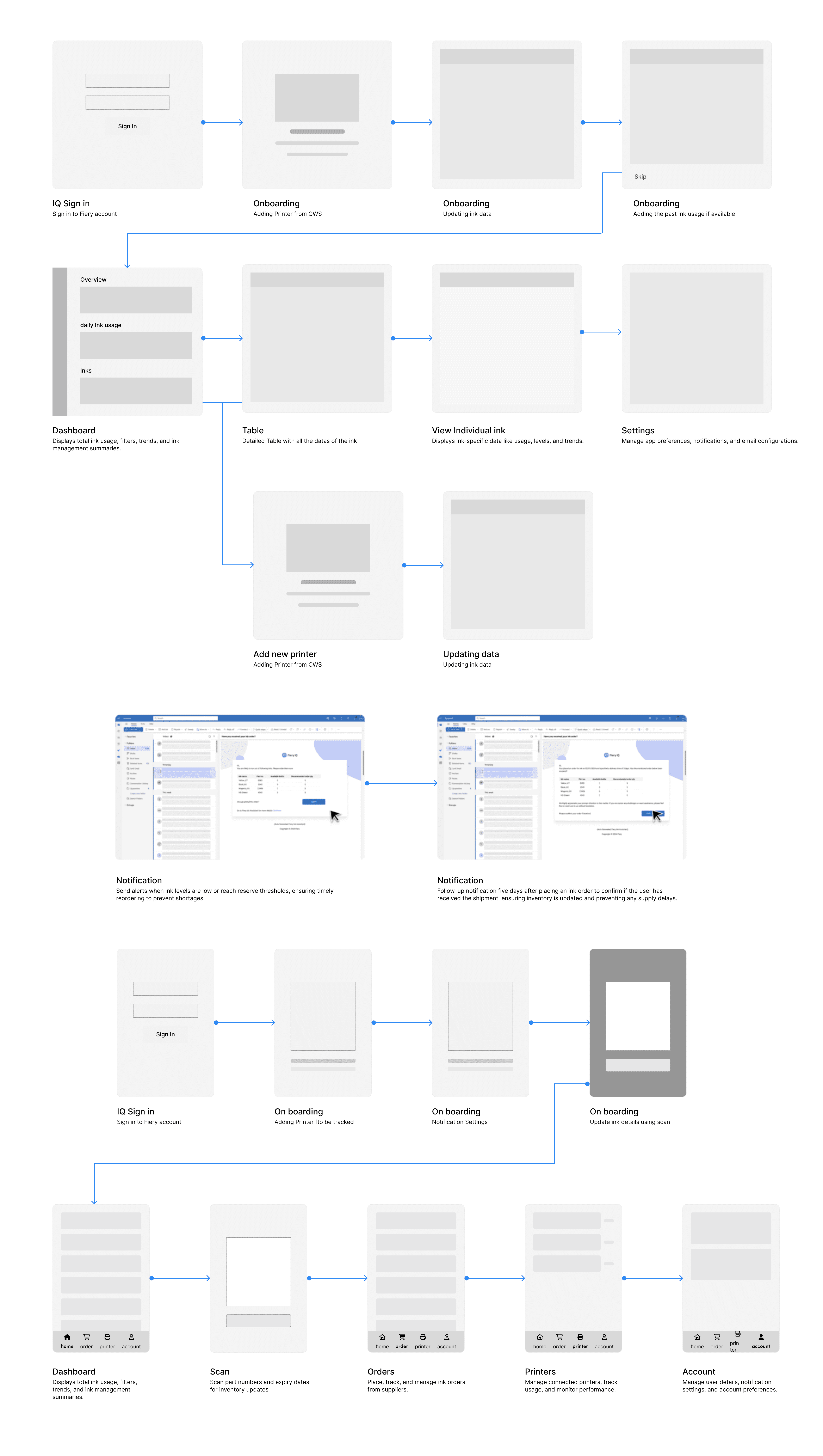
This is a high-level user flow showing how users move through InkWise from onboarding to daily inventory actions. For validation, we also created task-specific flows focused on scanning and reordering.
Primary flow highlights how users scan ink, gain real-time visibility, and receive proactive reorder signals, while secondary paths support configuration and monitoring.
The Moment of Truth
After internal alignment, we validated the solution with stakeholders and real users. Wireflows were reviewed with leadership and product teams for business and technical alignment, followed by moderated usability testing with print shop owners to confirm the flows were intuitive, fast, and effective in real-world scenarios.
The expiry alert initially tested well in isolation, but when combined with the dashboard, users missed it entirely. We made it more prominant in the dashboard
The validation sessions confirmed that the core workflows were intuitive and aligned with both business and user needs. Users were able to complete critical tasks such as scanning ink and checking inventory status without guidance, validating our focus on speed and simplicity. Stakeholder feedback reinforced confidence in the MVP scope, allowing the team to move forward with implementation.
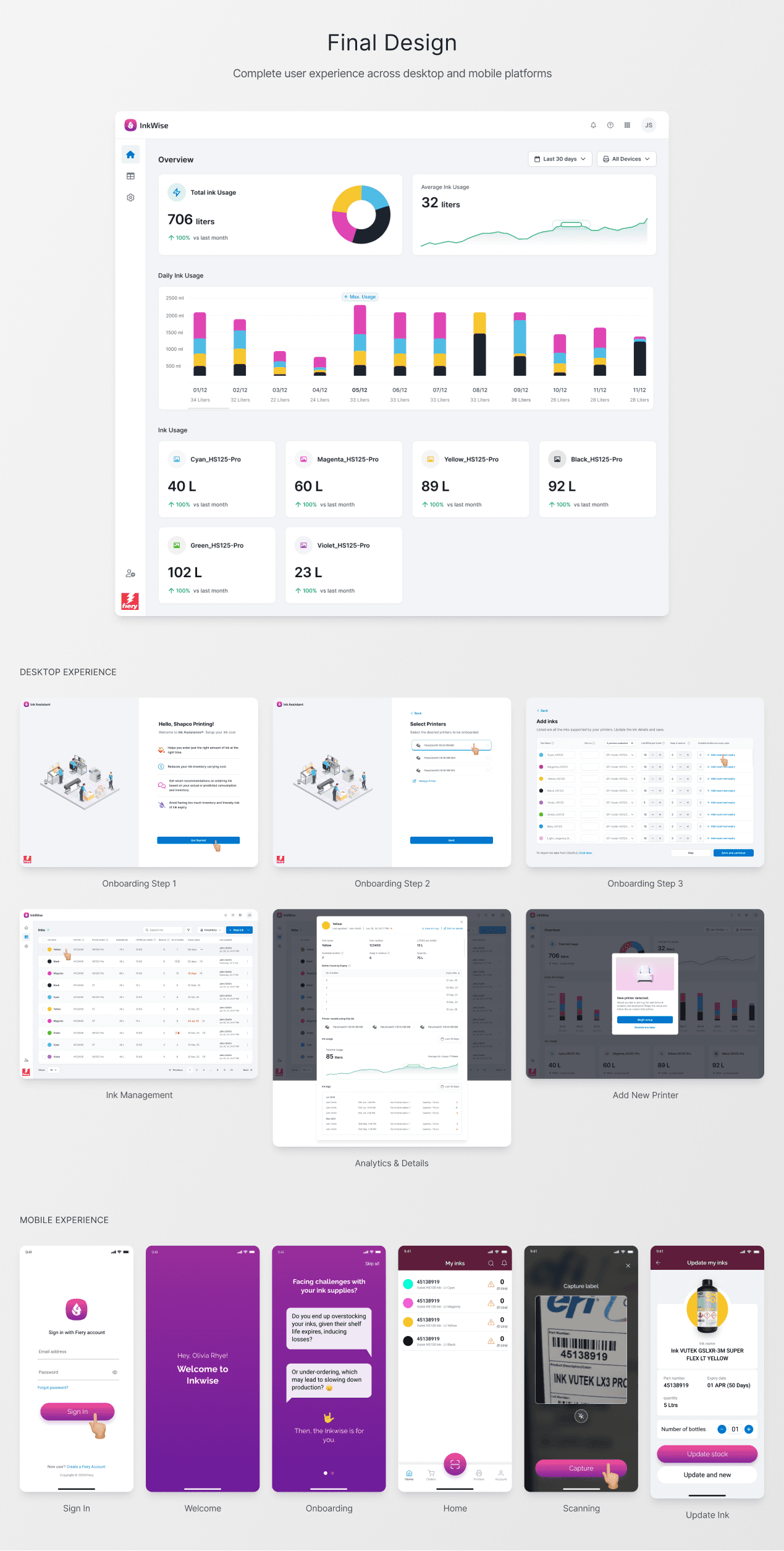
What We Built
The final design translates validated insights into a fast, intuitive inventory system that reduces effort, prevents waste, and supports confident decision-making
Did It Actually Work?
With the final high-fidelity interface complete, we moved into a second round of Usability Testing. Our goal was to validate that the visual hierarchy supported our core features. Visual hierarchy tested well, users could identify stock status at a glance without any issues.
After validating the final designs with users, I prepared the Handoff Documentation, including a component library and interaction specs, to ensure a seamless transition for the engineering team
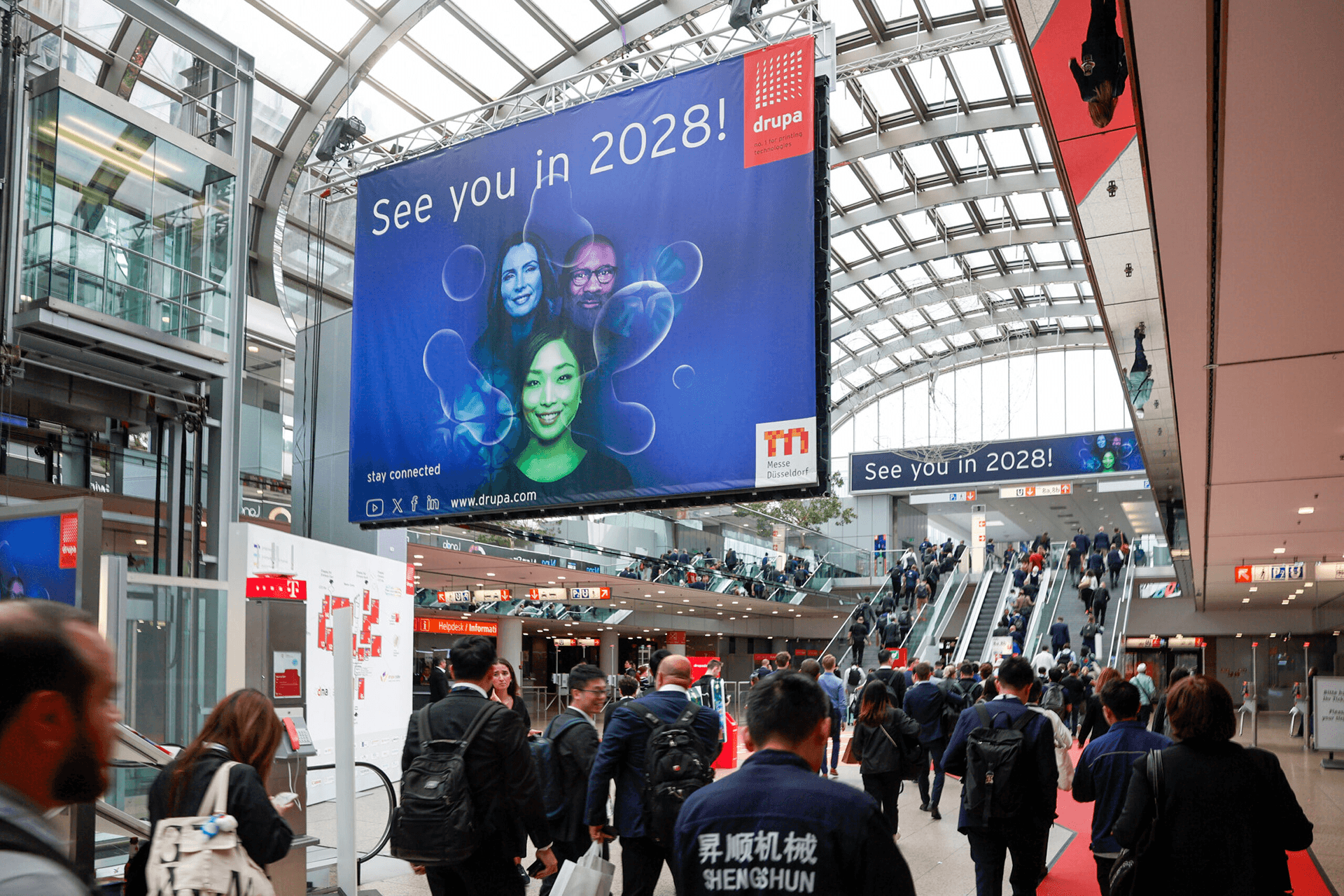
Taken to the World Stage - Drupa 2024
We proudly showcased our InkWise app at Drupa 2024, Europe's leading event for specialist print technologies, happened in Germany. The feedback we received was overwhelmingly positive. Before the official launch, InkWise was featured as EFI's key showpiece for the event. We surpassed expectations, being one of the few companies to introduce AI to the printing industry. InkWise earned its place among the best apps showcased at the event, marking a significant achievement in bringing innovation to the sector.
Earning Trust First
After launch, we intentionally kept InkWise freemium for nearly a year to reduce adoption friction and observe real usage patterns at scale. This allowed us to validate whether the product could naturally integrate into daily inventory workflows before introducing subscription barriers. Over time, usage shifted from exploratory to habitual, confirming that InkWise was solving a recurring operational problem rather than a one-off need.
Our goal wasn’t feature completeness, but repeated use under real operational pressure.
The Numbers Don't Lie
Transition to Feature Mastery: Analyzed user behavior shifts from "Exploratory" browsing to "High-Utility" task completion. This longitudinal study proved the interface’s intuitiveness as users required less time on-page to achieve core goals over the 12-month period.
Predictive Alert Optimization: Tracked a 200% month-over-month increase in the Click-to-Action (CTA) rate on predictive alerts. This validated a behavioral shift where users moved from passive notification viewing to active reliance on the system for inventory management.
Flow Efficiency & First-Time Success: Monitored the "Ink Scanning" flow using event logs, achieving an 80% First-Time Success Rate. This confirmed that the new interaction model successfully minimized "looping" or "abandonment," ensuring high data-entry accuracy for the MVP.
Conversion Funnel Optimization: Performed Funnel Analysis on the reordering flow, identified a friction point between "Ordering" and "Scanning Bottles." By optimizing the UI transition, sustained an good 80% completion rate through the final purchase step.
Retention & Habituation: Segmented the 12-month freemium cohort, revealing a 70% Retention Rate. This high level of "stickiness" indicated that the product successfully transitioned from an occasional tool to a daily habit, creating a high-propensity lead list for the upcoming subscription launch.
The Bigger Picture
By 2026, InkWise had established a strong and consistent user base, contributing to Fiery’s broader shift toward a subscription-driven software strategy discussed during the Fiery All Hands. InkWise helped validate increased investment in software products beyond hardware. This project reinforced for me that monetization becomes viable only after a product earns trust through sustained behavior change.
The real success of InkWise was not adoption, but the transition from intentional use to automatic behavior.